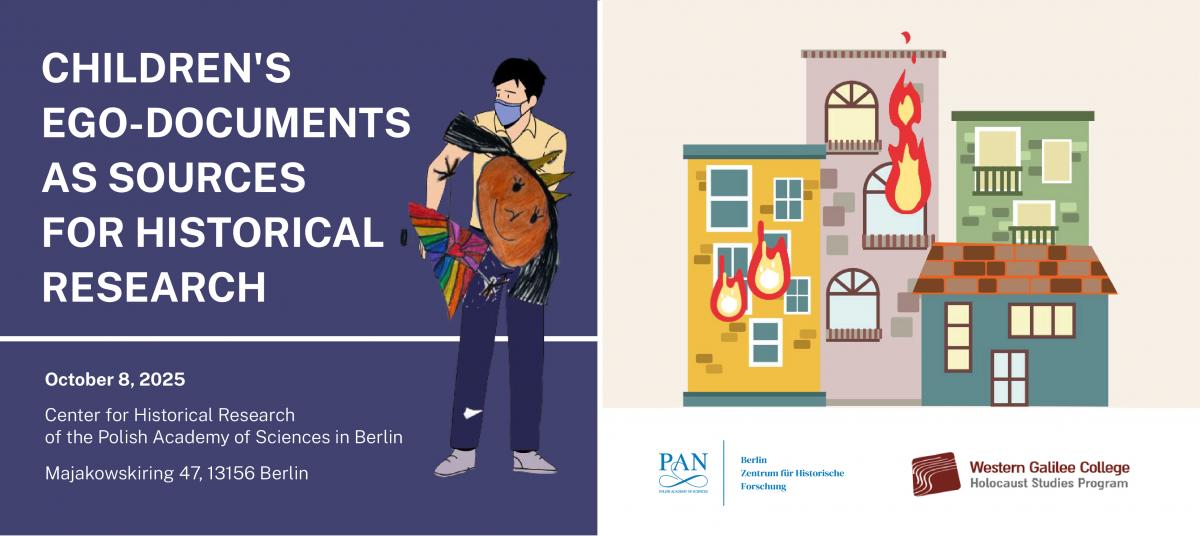
CHILDREN'S EGO-DOCUMENTS AS SOURCES FOR HISTORICAL RESEARCH
"My beloved parents, my father, my mother, and even my sister were killed during the liquidation
of the Kraków ghetto. In all those camps, I worked very hard, I walked around without clothes
and was badly beaten, I also suffered from many diseases, and all this when I was still a child."
Workshop organized by the Center for Historical Research of the Polish Academy
of Sciences in Berlin in cooperation with the Holocaust Studies Program
at the Western Galilee College in Israel.
The workshop will take place on October 8 this year at the headquarters of the Center for Historical Research of the Polish Academy of Sciences in Berlin, Majakowskiring 47, 13156 Berlin.
This is the testimony of a child who survived the Holocaust and wrote down its memories in a short paper after the war. Children, as witnesses to war, escapes, deportations, and genocide, have always left their testimonies behind. For the most part, these do not present the historical “truth” or facts that can be used to reconstruct the past. Instead, they contain personal thoughts, feelings, and conscious or unconscious motives for their actions. The personal documents they created, such as diaries, letters, journals, or drawings etc., are a challenge for historians and raise many difficulties in terms of the critical use of these sources. With the “emotional turn” in historical research, this type of source has grown in importance in recent years.
The workshops are devoted to self-testimonies produced by children and adolescents and the methodological problems they pose. How should such testimonies be interpreted and what is their significance for scientific research? What kind of information can they provide and how should this information be interpreted? We invite historians, as well as representatives of the humanities and related research disciplines who deal with ego-documents created by children and adolescents in their work, to participate in the workshop.