
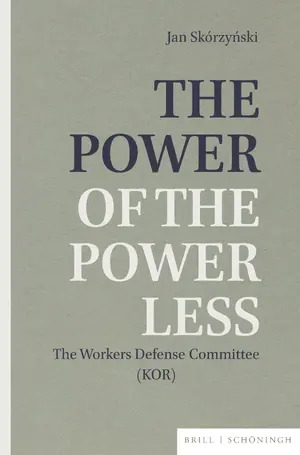
The Workers’ Defence Committee (KOR) was founded in 1976 in Poland. Its primal objective was to help people persecuted by the state. A year later it was transformed into the Committee for the Social Self-Defence ‘KOR’, which took up the continuous struggle for civil rights. Several hundred activists of the dissent movement created a parallel world in which the germs of civic society emerged – uncensored press and publishing houses, independent groups of students and farmers, the Flying University and free trade unions. Thus, KOR’s founders created the new model of opposition in the communist system: acting openly in the framework of the law, founded on human and civil rights, non-violent, focused on reconstructing social ties and social consciousness, inciting social activity. This evolutionary strategy set the direction of democratic transition in Poland.
The volumes in the series Poland in Europe by the Berlin Center for Historical Research of the Polish Academy of Sciences are intended to open up new perspectives on this country to the German and international public. Poland's history and culture are part of the common European space of experience and its values. With outstanding works from the humanities, literature and essay writing, published for the first time in German or English, but also through source editions, the history of Poland is brought closer to the readers in its European context.