Klaus Zernack Colloquium 2026 #4
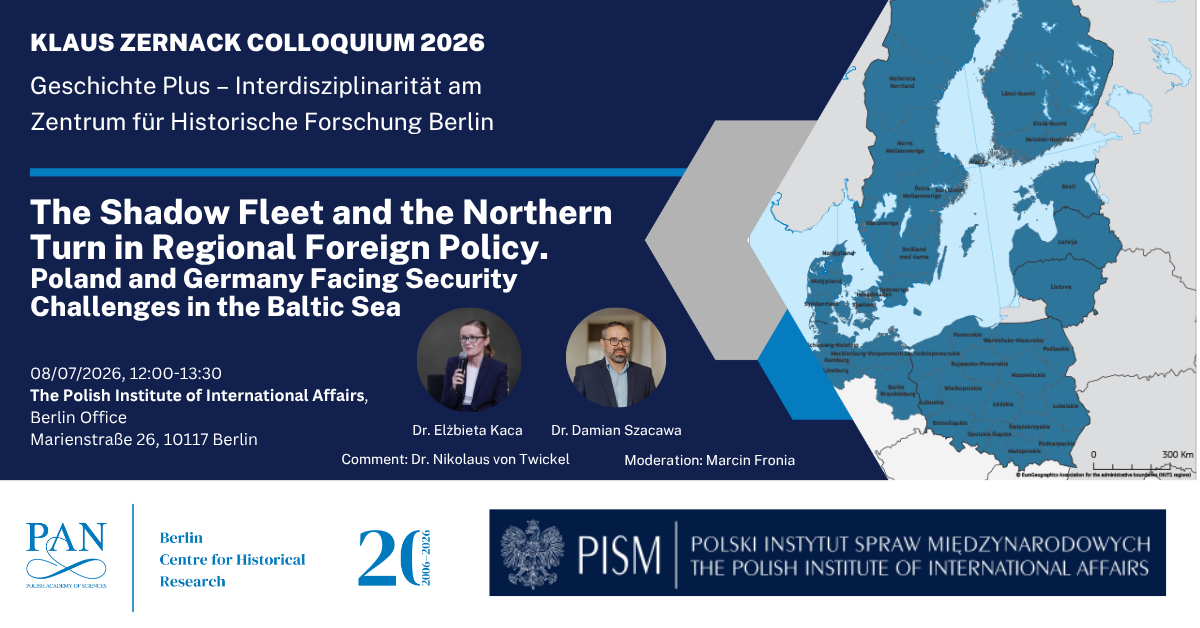
The Shadow Fleet and the Northern Turn in Regional Foreign Policy.
Poland and Germany Facing Security Challenges in the Baltic Sea
Moderation: Marcin Fronia (CBH PAN Berlin)
Date: 08/07/2026, 12:00-13:30
Location: PISM Office, Marienstr. 26, 10117 Berlin
Organizers: CBH PAN Berlin, PISM Berlin
If you would like to attend, please reply by 30 June 2026, marcin.fronia@cbh.pan.pl
The Baltic Sea has emerged as one of the most strategically consequential regions in contemporary European security. Russia's full-scale invasion of Ukraine in 2022 has triggered a fundamental transformation of the regional security architecture, from the accession of Finland and Sweden to NATO, to the rapid militarisation of the eastern flank and the growing threat posed by hybrid operations targeting critical undersea infrastructure. Against this backdrop, two interconnected phenomena demand urgent interdisciplinary analytical attention: the expansion of Russia's so-called shadow fleet operating in Baltic waters, and the broader geopolitical reorientation of regional states towards new alliance frameworks and partnerships.
This expert discussion brings together specialists in international security, foreign policy, geopolitics, and related social science disciplines to examine these challenges through complementary analytical lenses in an interdisciplinary perspective. The first is provided by recent research on Russia's shadow fleet — an opaque network of vessels used to circumvent Western sanctions, generate revenue for the Russian war economy, and conduct hybrid operations in the Baltic Sea. The second is the concept of Poland's "Northern Turn" in geopolitical culture, which captures the country's deepening strategic, economic, and socio-cultural ties with Nordic and Baltic partners in response to the shifting regional security environment.
This conversation will explore how Poland and Germany, two of the largest actors on NATO's eastern and northern flanks, are responding to these intertwined challenges. What implications does the shadow fleet have for regional deterrence and critical infrastructure protection? How does Poland's reorientation toward the Nordic-Baltic space reshape the region's security geometry, and what role does Germany play in this evolving architecture? In which areas do Polish and German strategic interests converge and diverge?
The discussion draws on two recent texts as its point of departure: Damian Szacawa and Piotr Oleksy's analysis of the "Northern Turn" in Poland's geopolitical culture, published in the Yearbook of the Institute of East-Central Europe (2025), and a recent PISM research report by Elżbieta Kaca and Tymon Pastucha on Russia's shadow fleet and the balance sheet of Western sanctions (first presentation in Germany). Together, these works offer a rich empirical and conceptual foundation for thinking about the Baltic Sea as a multidimensional theatre of security competition, combining military, economic, political, and societal dimensions.
This event is intended for researchers, policy analysts, practitioners, and all those interested in the evolving security dynamics of the Baltic Sea Region.
The expert round-table discussion format is designed to encourage a fruitful exchange of views among the participants.
We are publishing both texts below. The PISM report is available in English and Polish. The meeting will mark its first presentation in Germany.
Dr Damian Szacawa is an international relations scholar at Maria Curie-Skłodowska University (UMCS) in Lublin and Head of Nortnern Team at Institute of Central Europe in Lublin. He specializes in European security, regional cooperation in the Baltic Sea area, and foreign policy analysis. His research focuses in particular on Nordic-Baltic cooperation, NATO adaptation, and Poland’s evolving geopolitical orientation.
Dr Elżbieta Kaca is a political analyst at the Polish Institute of International Affairs (PISM), working on European Union policies, sanctions regimes, and economic statecraft. Her research addresses the intersection of security and economic instruments, including sanctions effectiveness and hybrid threats in the context of European and transatlantic relations.
Marcin Fronia is a researcher at the Centre for Historical Research of the Polish Academy of Sciences in Berlin (CBH PAN) and international security analyst at ProSafe Institute in Poland. His research focuses on security analysis in the Baltic Sea region, Polish-German relations, and foreign policy dynamics in Central and Northern Europe. His work addresses civil security, as well as responses to hybrid threats and disinformation affecting contemporary European societies.
12:00 Welcome Coffee. Networking
12:30 Official Welcome by Małgorzata Gemen, Executive Director, PISM Berlin Office
12:35 Elżbieta Kaca. Keynote remarks
12:45 Dr. Damian Szacawa. Keynote remarks
12:55 Comment: Nikolaus von Twickel (Zentrum Liberale Moderne)
13:00 Opening of the expert roundtable discussion, Moderator: Marcin Fronia, CBH PAN
13:30 End of the discussion